STELLAR CARTOGRAPHY - KUVALAE SYSTEM
KUVALAE SYSTEM
SYSTEM INFORMATION
- System Name: System M-105 Cygnus
- Traditional Name: Kuvalae
- Location: Alpha Quadrant, Sector 24 50 51472
- Type: G6V (Yellow Main Sequence)
PLANETS
| Pos. | Name | Class | Diameter | Density (Composition) | Gravity |
|---|---|---|---|---|---|
| I | Kuvalae I | N | 6,338 km | 3.3 (Low Iron) | 0.30g |
| – | Asteroid Belt | – | – | – | – |
| II | Kuvalae II (Antara) | M | 12,875 km | 5.0 (Medium Iron) | 0.92g |
| – | Asteroid Belt | – | – | – | – |
| III | Kuvalae III | D | 9,092 km | 6.8 (High Iron) | 0.88g |
| IV | Kuvalae IV | J | 65,075 km | 2.00 (Gas Giant) | 1.85g |
| V | Kuvalae V | J | 36,740 km | 1.8 (Gas Giant) | 0.94g |
| – | Asteroid Belt | – | – | – | – |

ANTARA
Traditional Name: Antara
- Position in System: II
- Number of Satellites: 1
- Mean Density: 5.0 g/cm3
- Mass: 5.59 x 1024 kg
- Planetary Gravity: 0.92G
- Planetary Size
- Diameter: 12,875 km
- Equatorial Circumference: 40,725 km
- Total Surface Area: 520,768,070 km2
- Percent Land Mass: 40%
- Total Land Area: 208,307,228 km2
- Volume: 1.117 x 10¹² km3
- Planetary Conditions
- Length of Day: 24 hours
- Length of Year: 0.84 Earth Years (297.3 days)
- Atmospheric Density: Normal
- Mean Atmospheric Pressure (sea level): 98.2 KPa (0.97 atm)
- Axial Tilt: 11.2°
- Seasonal Variation: Minor
- General Climate: Cool temperate
- Mean Temperature at 30° Latitude
- Low: 5° C
- Average: 16° C
- High: 28° C
Planetary Profile
Note: the name of the system's primary (Kuvalae) and the name of the inhabited second planet (Antara) are based on linguistic analysis of the regional dialect in the area of the target continent investigated by the USS Melbourne. These are used here as placeholders and should not be considered as consensus names held by the majority of the planetary population.
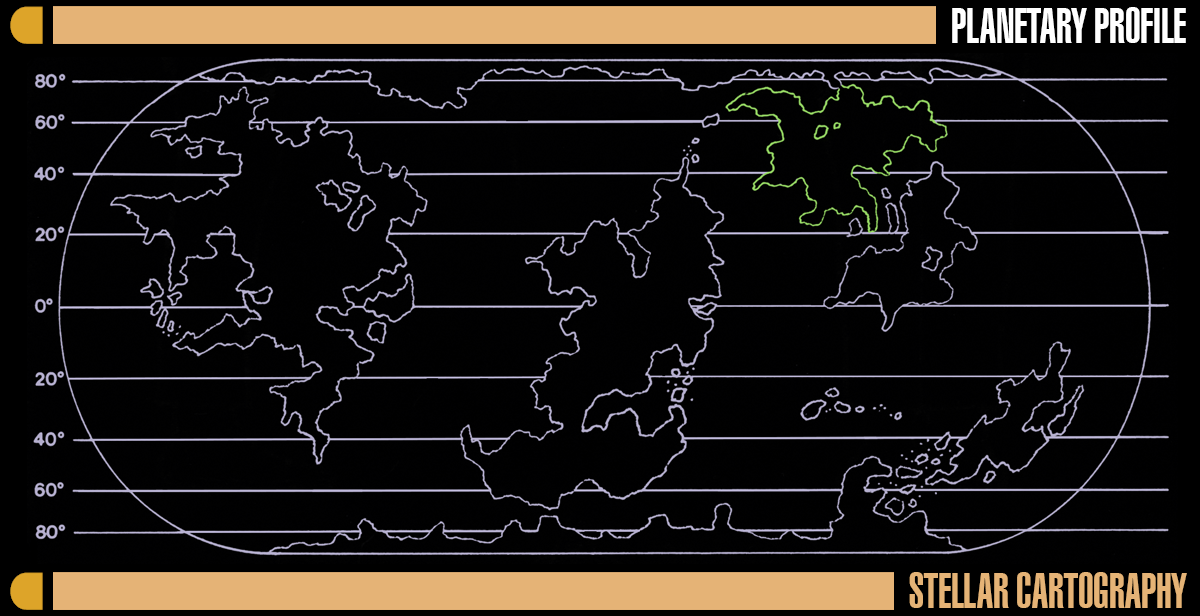
Antara, the second planet in the system, is an Earth-sized class M world with a temperate climate. Similar to Earth, Antara also has a single, oversized moon. The planet's axial tilt is less than that of Earth, resulting in less seasonal variation. There is a total of eight continents, including both an Arctic and Antarctic land mass, representing approximately 40% of the surface area of the planet. A standard range of terrain types is represented across the planet.
The dominant species on Antara is an intelligent humanoid following the common evolutionary pattern established in Hodgkin's Law of Parallel Planetary Development.
Antaran Physiology
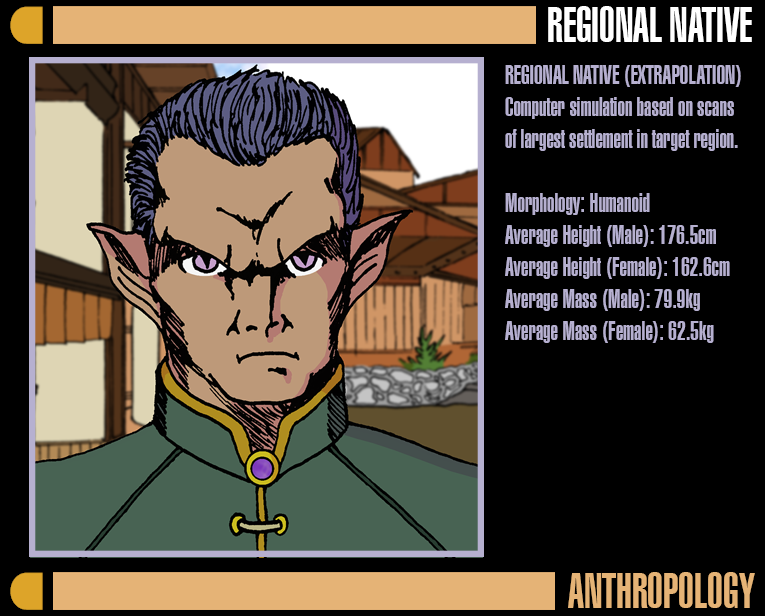
Externally, Antarans are distinguished by a large textured brow ridge and large ears. Antaran eyes contain a slit pupil, granting them greater range of night vision than humans. Antarans are of similar height and mass as humans, with the females being on average slightly small than the males. Eye and hair color tends towards more exotic pigments than is usual in other humanoid species, with purple, blue, green and orange hues being relatively common. Skin color in population inhabiting the region of the northern continent investigated by the USS Melbourne tends towards a light brown or tan pigmentation.
Most information on the Antaran people is based on the limited sample size from the region investigated by the USS Melbourne. Orbital scans show that all eight continents, including the two polar regions, are inhabited; indicating the possibility of a wide variation in appearance across a population of approximately 500 million.
Culture
Scans conducted from orbit imply a wide variation in culture and technological development across the planet. The investigation conducted by the USS Melbourne focused on the port city of Sembra, an independent city-state located within the Kingdom of Siral on the northern island continent of Eches. The nation states on Eches appear to be the most advanced on the planet, but this is only approximately Level 3 on the Federation Technological Index Classification System, roughly the equivalent of the European Renaissance period of Earth history.