STELLAR CARTOGRAPHY - DRAKE'S FOLLY
426 DRACONIS SYSTEM
SYSTEM INFORMATION
- System Name: 426 Draconis A
- Traditional Name: Dragonfire
- Location: Alpha Quadrant, Sector 15 33 41723
- Type: G6V (Yellow Main Sequence); binary of 426 Draconis B (M2V, Red Dwarf)
PLANETS
| Pos. | Name | Class | Diameter | Density (Composition) | Gravity |
|---|---|---|---|---|---|
| I | Lockheed | B | 10,353 km | 3.9 (Low Iron) | 0.58g |
| II | Drake's Folly (Fafnir) | N | 11,659 km | 5.6 (Medium Iron) | 0.93g |
| III | Drogon | D | 6,782 km | 4.1 (Low Iron) | 0.40g |
| IV | Rhaegal | D | 7,500 km | 3.3 (Low Iron) | 0.35g |
| – | Asteroid Belt | – | – | – | – |
| V | Viserion | D | 5,025 km | 3.9 (Low Iron) | 0.45g |
| VI | Glaurung | J | 68,869 km | 1.0 (Gas Giant) | 1.03g |
| VII | Ancalagon | J | 142,543 km | 1.4 (Gas Giant) | 2.80g |
| VIII | Scatha | J | 84,738 km | 0.9 (Gas Giant) | 1.13g |
| IX | Smaug | J | 104,748 km | 1.0 (Gas Giant) | 1.48g |
| X | Tiamat | J | 132,967 km | 1.2 (Gas Giant) | 2.30g |

Note: the companion star 426 Draconis B has an eccentric orbit that ranges from 228 AU to 684 AU from the primary (mean orbit 456 AU), far enough to allow it to retain its own small system of seven planets. Most of these worlds are small, low-density silicate ice worlds with no atmosphere, with one just large enough to have an atmosphere but so far from the star that the volatile chemicals have all frozen out and condensed on the surface. The second world of the system, while still a Class P ice world, is large and dense enough to have an atmosphere and a gravity of 0.97G and is home to a small but thriving colony of Andorians.
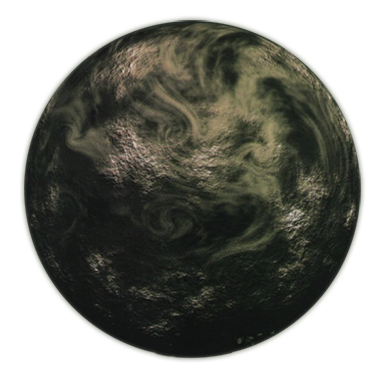
DRAKE'S FOLLY
Traditional Name: Drake's Folly, Fafnir
- Position in System: II
- Number of Satellites: 0
- Mean Density: 5.6 g/cm3
- Mass: 4.67 x 1024 kg
- Planetary Gravity: 0.93G
- Planetary Size
- Diameter: 11,659 km
- Equatorial Circumference: 36,628 km
- Total Surface Area: 427,038,727 km2
- Percent Land Mass: 60%
- Total Land Area: 256,223,236 km2
- Volume: 8.30 x 10¹¹ km3
- Initial Planetary Conditions
- Length of Day: 33.46 hours (1.39 days)
- Length of Year: 0.24 Earth Years (86.34 days)
- Atmospheric Density: Hyperdense
- Mean Atmospheric Pressure (sea level): 9,834.8 KPa (98.05 atm)
- Axial Tilt: 12.9°
- Seasonal Variation: Minor
- General Climate: Molten
- Mean Temperature at 30° Latitude
- Low: 608.1° C
- Average: 649.3° C
- High: 690.4° C
- Current Planetary Conditions (2380)
- Length of Day: 33.46 hours (1.39 days)
- Length of Year: 0.24 Earth Years (86.34 days)
- Atmospheric Density: Superdense
- Mean Atmospheric Pressure (sea level): 2,483.7 KPa (24.5 atm)
- Axial Tilt: 12.9°
- Seasonal Variation: Minor
- General Climate: Superheated
- Mean Temperature at 30° Latitude
- Low: 208.1° C
- Average: 230.6° C
- High: 247.4° C
Planetary Profile
Drake's Folly is a Class N world in the process of being terraformed to Class M. Half a century of terraforming efforts have had a drastic effect, but the planet still remains uninhabitable with an incredibly dense, superhot atmosphere. Beneath the toxic miasma, the terrain alternates between deep canyons and towering jagged mountain peaks. Surprisingly, a large liquid ocean has managed to survive on the surface, though the high atmospheric pressure means it is highly acidic. The sole settlement is located near the peak of the planet's highest mountain, the Dragon's Tooth, which rises nearly 21 kilometers into the atmosphere. Surrounded by the massive atmospheric processors, the settlement is primarily built into the mountain, where environmental seals keep the interior habitable. Deeper into the mountain's interior are the extensive mines for extracting the precious ores that first drew colonists to this hellish world. The peak of the Dragon's Tooth also serves as the base for a space elevator that connects to an orbital space station constructed into a captured asteroid.
History
The 426 Draconis binary system was first studied by Federation probes and long range scans in 2279. The scans revealed that the second planet in the 426 Draconis A system contained unusually high amounts of valuable, energy-rich minerals like Galicite and Pergium. The distance of the system from the Federation border of the time means that a colonization effort was not undertaken for several decades. When the first colony ship arrived in 2328 they discovered that the probes been fooled by the size of the planet's largest peak and had underestimated the planetary conditions. The long range survey report had indicated that second planet in the 426 Draconis A system was a marginal Class N that could be terraformed relatively quickly. Based on their more detailed scans, the colonists realized that it would take the better part of a century to make it habitable.
Despite the reality of the situation, the colonists knew there was no turning back. They picked the peak of the highest mountain as the site of their settlement, not just because it was the (relatively speaking) safest location but because, while the probes had underestimated the severity of the conditions, they had not been wrong about the wealth of valuable materials to be mined and the mountain proved to be a rich source. The atmospheric processors and other terraforming equipment was set up and started running, and then the colonists started digging. The planet's official designation was "Fafnir", following a convention of naming the system's planets after dragons from Earth fiction and legend, but the locals soon began calling it Drake's Folly, after the Starfleet astronomer who had filed the original, erroneous report on the planet.
Today, fifty years of terraforming effort have made the planet less toxic, but it is still far from habitable. The colonists estimate it will be another 25 to 30 years before the surface temperature and atmospheric pressure will be within the range of Class M worlds, at which point it will take another decade of bioengineering to establish a breathable atmosphere with a self-sustaining oxygen cycle. The colonists have not been idle. The primary mine is now a maze of tunnels running deep into the Dragon's Tooth, and secondary mining operations have been established on some of the neighboring peaks. To facilitate transfer of the mined resources off-planet, a small asteroid was diverted from the system's belt and turned into a space station in geosynchronous orbit above the main settlement. A space elevator was then built connecting the resource processing center on the peak of Dragon's Tooth to the space station.
The Drake's Folly settlement remains a frontier colony, with a tough, independent population. Conditions have greatly improved since the colony was founded a half-century ago, but remain well below the standard of most Federation worlds.
Population
From an initial 158 colonists, Drake's Folly has grown to a population of over 1,200. The majority of the population are of human descent, but there are a few hundred Tellarites living there as well. More recently a group of Tyran engineers joined the colony, bringing their mining expertise as well as a small number of Exocomps, sentient utlity robots. These new arrivals have helped spur rapid advancement in the technological level of the colony's facilities.