STELLAR CARTOGRAPHY - THE FIRMAMENT
RAYA SYSTEM
SYSTEM INFORMATION
- System Name: FGC-413618 (Federation Astronomic Catalog)
- Traditional Name: Raya
- Location: Alpha Quadrant, Sector 14 15 72819
- Type: G2V (Yellow Main Sequence)
PLANETS
| Pos. | Name | Class | Diameter | Density (Composition) | Gravity |
|---|---|---|---|---|---|
| I | Atrathis | M | 10,273 km | 7.04 (High Iron) | 1.03g |
| II | Drall | K | 11,825 km | 6.7 (High Iron) | 1.1g |
| III | Harak | J | 81,278 km | 1.3 (Gas Giant) | 1.5g |
| – | Asteroid Belt | – | – | – | – |
| IV | Adnun | J | 83,252 km | 1.6 (Gas Giant) | 1.9g |
| V | Cabul | J | 80,311 km | 1.7 (Gas Giant) | 1.95g |
| VI | Rozal | J | 84,481 km | 0.9 (Gas Giant) | 1.1g |
| VII | Tefnu | J | 82,903 km | 1.4 (Gas Giant) | 1.6g |
| – | Asteroid Belt | – | – | – | – |

ATRATHIS
Traditional Name: Atrathis
- Position in System: I
- Number of Satellites: 1
- Mean Density: 7.04 g/cm3
- Mass: 3.996 x 1024 kg
- Planetary Gravity: 1.03G
- Planetary Size
- Diameter: 10,273 km
- Equatorial Circumference: 32,274 km
- Total Surface Area: 331,546,501 km2
- Percent Land Mass: 42%
- Total Land Area: 139,249,530 km2
- Volume: 5.68 x 10¹¹ km3
- Planetary Conditions
- Length of Day: 23 hours (0.96 days)
- Length of Year: 0.68 Earth Years (249 days)
- Atmospheric Density: Standard
- Mean Atmospheric Pressure (sea level): 104.36 KPa (1.03 atm)
- Axial Tilt: 26.1°
- Seasonal Variation: Moderate
- General Climate: Warm Temperate
- Mean Temperature at 30° Latitude
- Low: 15.1° C
- Average: 26.3° C
- High: 38.4° C
Planetary Profile
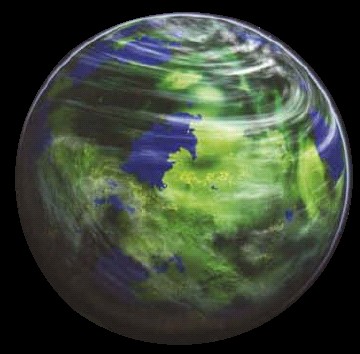
Atrathis is smaller than Earth, but denser so it has a gravity only slightly higher than Earth's. While tectonically active, the planet's land masses are concentrated in a single super-continent, with the rest of the surface covered in ocean, itself filled with many island chains. Atrathis has polar ice caps, and the planet's axial tilt gives it seasons like on Earth. The average temperature is slightly cooler than Earth, giving much of the main continent weather comparable to Europe. This greatly aided the survival of transplanted Earth flora and fauna, which has integrated into the existing biosphere. That this did not result in an ecological catastrophe is a testament to the efforts of the Preservers.
Aduan Physiology
As a related species of the genus Homo, physically the Aduan closely resemble humans, though shorter and stockier. Aside from height, the Aduan average 165 cm tall for males and 155 cm for females, the primary visible difference is in the facial features where the Aduan have larger, wider noses and a more prominent sloped brow than humans. Hair color tends towards brown and black, though red hair is not unknown, and males also display facial hair which the females lack. Facial hair appears to have cultural significance, as the males often style and decorate their beards, and a clean shaven male Aduan is a rarity. The biggest difference with humans, however, is the psionic potential of the Aduan. Virtually all adult Aduan have at least an empathic talent, with some exhibiting full telepathic ability, especially among the females.
Aduan are hardier than humans and require almost double the caloric intake to maintain their physiology than humans. While capable of speech, the Aduan language is relatively unsophisticated as they have come to rely on their empathic abilities to convey nuances in communication rather than through speech.
Government
The Firmament is an interstellar government, centered on the Aduan homeworld of Atrathis. The other planets in the Firmament are colony worlds, with limited self-governance focused on local affairs. The Firmament is an evolution of the unified planetary government of Atrathis, which was a constitutional federation of the old nation states. The Constitution has evolved along with the Aduan culture, and government is made up of representative ministers elected from each of the former nation states, and a single representative from each of the colony worlds. The Council of Ministers elects one of their own to serve as Prime Minister and head of state for the Firmament. The current Prime Minister is named Vadran dur Orzur.
With no internal conflict, and no hostile alien species in the sector, the Aduan do not have a dedicated military any longer. Their planetary peacekeeping force eventually merged with the interstellar exploration corps to create a unified Star Force with a loose military-like hierarchy. The central command structure on Atrathis is more rigid, with the current supreme commander being Admiral Randar dur Elian Far Traveler. On individual starships the hierarchy can be less rigid, with a Captain and a designated Second in command but below that only an informal structure.
History
Tens of thousands of years ago the Preservers transplanted a population of Homo Neanderthalensis, along with many Pleistocene flora and fauna, from Earth to a distant world in the Alpha Quadrant. Without competition from Homo Sapiens these Neanderthals avoided extinction and over the intervening millennia have developed into a technologically advanced spacefaring people.
The planet they were transplanted to was smaller than Earth but denser. It had a single large continent with a major ocean dotted with many islands. There were enough resources to allow the tribes to coexist and the Aduan, as they came to call themselves, thrived. The peoples who colonized the island chains of the great ocean became exceptional sailors and navigators whose descendants would lead the Aduan people to the stars. Conflicts did not start until civilizations had evolved past the hunter gatherer stage and were more for cultural dominance, though if one group controlled a desirable resource there could be competition. The last major conflict occurred during the planet's early industrial age, with the kind of horrific warfare comparable to Earth's First World War. In this instance the peace that ensued led to a unified world government, preventing a more devastating later conflict once atomic, biological and chemical weapons had been developed. It was under this unified government that the planet's space program started, taking them first to low orbit and later to their moon and the other planets in their star system.
Atrathis's moon proved to be rich in dilithium, leading to the discovery of warp travel almost two centuries ago. Archaeological and genetic research showed that the Aduan people and many of the planet's animal species were not native to Atrathis, with the fossil record for them ceasing abruptly at a fixed point in the planet's history. Further evidence for a distant origin for the peoples came from the discovery of a Preserver Obelisk on the Moon. Recent discoveries have also shown that the moon was not a natural satellite but a planetary mass object that had been placed in its stable orbit around their world in a way that it would mimic the behavior of the Earth's moon. With warp travel the Aduan people soon discovered and colonized other worlds, leading to the current interstellar government they refer to as The Firmament. Like many other sections of this region of the Alpha Quadrant, there were no other intelligent species within the same sector as Atrathis, though the Aduan did discover ruins of former alien civilizations on a handful of dead worlds. Their discovery of a Federation long range probe was the first indication of a potentially still-active alien civilization within contact range.
Culture
The inhabitants refer to themselves as the Aduan and their planet as Atrathis. The interstellar government centered on Atrathis and consisting of a dozen colony worlds is called The Firmament. The Aduan are craftspeople, with many skilled artisans. They have some music, but it is limited, a cultural aspect they did not seem to develop. The Aduan are omnivores, and because of their large appetites, food plays a major role in their culture.
Aduan cities are spread out, with wide flat buildings, frequently with step pyramid shapes. They do not build tall, but the architecture is very ornate, with many carvings and shapes built in. Technologically, the Aduan are at a level comparable to late 23rd century/early 24th century Federation technology. Atrathis is entirely powered by clean energy, with little pollution remaining from their Industrial Age. Seagoing vessels still play a large role in transportation due to the spread of civilization in the islands of the Great Ocean, with fusion-powered ships that augment their propulsion with giant kite sails.
Much like the Polynesians of Earth, the groups of Aduan who explored and colonized the island chains of the Great Ocean became highly skilled navigators and seemed imbued with a natural talent for exploration. The descendants of these peoples became the first astronauts of Atrathis and still make up much of their space exploration division.
Aduan names follow a naming chain along the patrilineal or matrilineal line. Male Aduan name chains begin with the given name followed by "dur" (son of) and the given name of the father, or of a notable male ancestor in some cases. Similarly, female Aduan name chains begin with the given name followed by "syr" (daughter of) and the given name of the mother, or of a notable female ancestor. During formal ceremonies, or for members of notable family lines, the name chain may be extended past the parent to the grandparents, great grandparents and even further. The name chain does also not necessarily need to follow a strict male or female line, if an ancestor of the opposite gender is particularly notable then they may be included in the chain. Aduan name chains can also contain epithets referring to the individual's occupation or a notable achievement.