MEDICAL EQUIPMENT
Medicine is an inherently complex field, and Starfleet medical officers have access to a wealth of medical equipment. Some of it is portable and can be taken along on away team missions, while much of it can only be used in a hospital or sickbay.
Sick Bay Equipment
Diagnostic Bed
All beds and examination tables in a sickbay are diagnostic beds, also referred to as biobeds. The diagnostic bed is a multi-function patient analysis and life-support system composed of three elements. Woven into the compression cushions lining the length of the bed is an enhanced sensor web that provides continuous data on vital signs. The folding support platform normally positioned over the patient's torso holds a standard sterilization field, dispensary systems for intravenous injections, solution preparations, a cardiovascular stimulator, and an auto-respiratory stimulator. Diagnostic screens provide continuous readouts of vital life signs in addition to other supplementary information, with an alarm system that is activated when readings fall below certain thresholds. Biobeds can also create force fields to restrain patients.

Cortical Stimulator
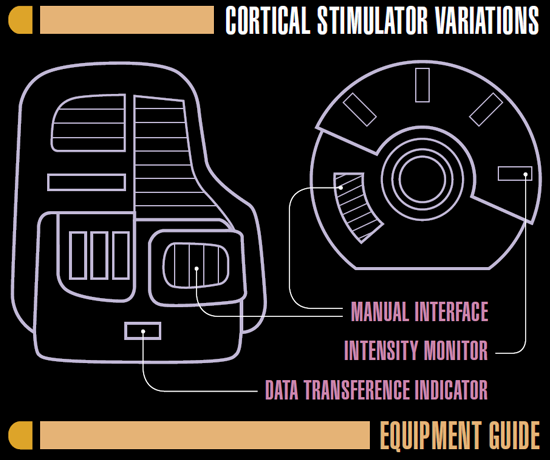
Designed to be attached to the head of humanoids, this small device uses electrical impulses to attempt to normalize and even restart the neural activity of sentient beings. It is commonly used to treat seizures, hallucinations, and similar short-term neurological problems and to attempt to awaken patients who are in comas, but physicians can also use it in life-and-death situations to attempt to restart the brainwaves of a humanoid who has recently died. When using this device to revive the dead, time is of the essence. The longer a humanoid's neural activity has ceased, the greater the chance that they cannot be revived. Also, any traumatic injuries or other problems that caused the patient's death must be repaired simultaneously, or this device will not be able to keep the patient's brainwaves going.
Stasis Chamber
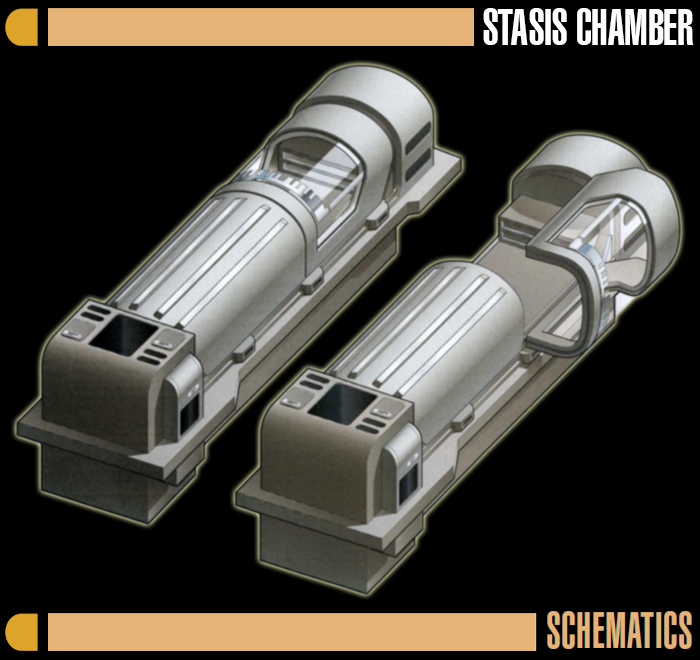
Two-and-a-half to three meters long, these rectangular, sarcophagus-like units are the last option for personnel who are suffering from a potentially fatal disease, or who have suffered a serious accident. Stasis chambers are primarily used to either keep critically ill or injured patients alive until they can be transported to treatment or, if all known treatments fail, to preserve the still living patient until a treatment for their illness could be developed. The stasis chambers may have to work independently of any Starfleet facility or starship, and as such are designed to be complete¬ly self-contained, with their own internal power supply. When active, the unit gives off a low, oscillating hum as it maintains the stasis field around its occupant; it can operate for a minimum of 17 days without any maintenance or adjustment. Stasis chambers can be used to store a patient indefinitely, although this is advisable only under constant medical super¬vision, and within the confines of a properly equipped facility.
Emergency Medical Hologram (EMH)
The Emergency Medical Hologram (EMH) is an artificial intelligence designed to mimic a humanoid and programmed with extensive medical knowledge. An EMH can operate in a sickbay equipped with holo-emitters and is intended to supplement or temporarily replace medical staff in emergencies. They are not designed to be self-aware, though there are exceptions. The USS Melbourne is equipped with a Mark IV EMH which presents as a human female in their early forties.

Field Equipment
Medicine is an inherently complex field, and Starfleet medical officers have access to a wealth of medical equipment, some of which is portable and can be taken along on away team missions.
Medical Tricorder
The underlying design of the medical tricorder is a standard tricorder - a portable (hand-held), multi functional device that integrates computers, scanning sensors, and data storage. Information gathered is analyzed by an internal computer that also displays the results on a tiny screen built into the tricorder. The differences between a medical tricorder and the standard model are its dedicated life-sign sensors, medical analysis computer, and library modules. To supplement the basic sensors, a stand-alone, close-range hand-held scanner collects and sends high-resolution readings to the medical tricorder.

Medical Support Kit (Medkit)
This standard first-aid kit provides an Away Team with a medical tricorder, including hand scanner; a hypo spray; a set of 100 cc hypo vials, typically three each of tri-ox compound, pain suppressants, and stimulants; four 4.5-centimeter plasticene splints; sterilized pressure bandages; fluorocarbon skin graft re¬placements; anti-radiation tablets, water purification tablets; and spare data crystals and power packs for a medical tricorder. The hypo spray is used to direct compressed ultrasonic waves against a specific area of the patient's body for the high-pressure, painless insertion of medicine directly through the skin layers into the bloodstream.

Pharmaceuticals
The Federation possesses a vast pharmacopeia of medicines. Some only work for a single species, but many function on most or all humanoids. However, detailed scans using a diagnostic bed or at least a medical tricorder are necessary to determine if a specific drug is likely to be safe or effective when used on a member of a humanoid species that is not in Starfleet's medical databases. The following are some of the drugs most often used by Starfleet medical officers.
Analgesic
- Anetrizine: Used as a local anesthetic to either relieve localized pain or to permit localized surgery or other potentially painful medical treatment.
- Asinolyathin: Muscle spasm pain relief.
- Hydrocortiline: A common pain medication often used for headaches.
- Melanex: A general anesthetic and neural paralyzer.
- Metorapan: General painkiller commonly used to treat pain from severe traumatic injuries. In less than 1% of cases metorapan could cause a potentially fatal allergic reaction.
- Propoxyphene Hydrochloride: A standard pain killer. An overdose can cause the user to fall into a coma, however.
Antibiotic
- Corophozine: An antibiotic often used to prevent secondary infections caused by other illnesses.
- Sterilite: A powerful antibiotic used to prevent infection during surgery or wound treatment. It is especially useful for field surgery.
Cardiovascular Aid
- Benjisidrine: An antiarhythmic and cardiostimulant for use with Vulcan patients.
- Impedirazine: A cardiostimulant that can also be used to counteract some psychoactives.
- Lectrazine: This drug is used to stabilize humanoid cardiovascular and renal systems. When given in combination with hyronalin it provides enhanced protection against radiation.
- Metrazene: Used to treat cardiac arrhythmias. Metrazene can be used in conjunction with other treatments to reduce the physiological response in the body of a non-Trill individual who has been joined with a Trill symbiont.
Sedative
- Ambizine: Powerful sedative capable of rendering patients unconscious.
- Anesthizine: A fast-acting anesthetic, frequently used for intruder defense and crowd control when dispersed in gaseous form.
- Axonol: A sedative used for psychiatric treatments. In gaseous form it can also be used as a crowd-control anesthetic.
- Dylamadon: A sedative that can simulate death in an individual.
- Improvoline: A standard sedative.
- Melorazine: Standard sedative used for calming struggling patients.
- Neural Paralyzer: Medication that can greatly reduce the metabolic functions of an individual, placing them in a death-like coma.
- Neurozine: A sedative gas used to incapacitate humanoids.
- Tetrovaline: Sedative used to render a patient unconscious. One side effect is a lowered immune response.
Stimulant
- Adrenaline: Acts as a light stimulant and light painkiller. Can be used as a cardiostimulant for resuscitating patients or for radiation treatment if hyronalin is not available.
- Cordrazine: Extremely powerful stimulant. Large doses will cause acute paranoia and possibly death. Cordrazine is only used in emergency situations.
- Cortolin: This drug helps restore normal breathing functions in humanoids who have stopped breathing due to injury.
- Cortropine: A stimulant that aids wakefulness and enhances sensory input, as well as assisting in focusing on specific tasks. Large doses are followed by a period of depression and overdose can cause death.
- Formazine: Standard Federation stimulant.
- Hyperzine: Used to counter cranial implant seizures.
- Inaprovaline: A synaptic stimulant and cardiostimulant and could be used as a preventative measure or in response to various physical illnesses.
- Lexorin: Used to counteract mental disorientation, whether from a head injury, mental disorder or psionic effect.
- Tricordrazine: A more powerful version of Cordrazine
Anti-radiation
- Arithazine: Used to treat radiation poisoning by deadly theta radiation, this drug can be given after exposure as a treatment or prior to likely exposure as a preventative against radiation damage.
- Hyronalin: Standard radiation treatment. Extensive use can cause death.
- Netrazine: Mild anti-radiation medication.
Other
- Alkysine: Used immediately after a patient suffers a neurological damage, like a spinal injury, this drug usually lessens the effects of the damage.
- Cervaline: An antirejection drug used to prevent rejection of transplanted tissue.
- Coradrenaline: Used for treatment of exposure and frost bite.
- Dermaline: This drug can be administered either as an injection or a gel applied to the patient's skin. It is used to treat first and second-degree burns.
- Dylovaline: A broad-spectrum anti-toxin.
- Hemosclerex: A hypercoagulant administered to a body location where there is bleeding.
- Immunosuppressant: Suppresses the immune system to prevent tissue rejection after a transplant operation.
- Masiform D: General poison antidote.
- Retnax V: Used to treat nearsightedness.
- Ryetalyn: A cure for Rigellian fever. It occurs naturally and cannot be synthesized.
- Stokaline: An injectable multiple vitamin compound.
- Strobolin: Cure for choriocytosis, a disease fatal to Vulcans.
- Theragen: Klingon nerve gas, when diluted and mixed with alcohol it prevents the debilitating effects of interphase.
- Tri-Ox Compound: Used to treat oxygen starvation. Useful during first aid treatment of decompression victims. Injections are given every three hours on planets where the thin atmosphere or low oxygen content would cause fatigue.
- Vertrazine: Used to combat vertigo.