Klingon Empire
The Klingon Empire is the home of the Klingon people and one of the preeminent interstellar powers of the region. While the majority of its territory lies within the Beta Quadrant, the Klingon presence is felt equally in the Alpha Quadrant. A proud, honorable warrior race, the Klingons have often been at odds with the other Beta Quadrant powers. For much of the past two and a half centuries relations between the Klingons and the Federation were hostile, sometimes resulting in open warfare, but the last 50 years have seen a gradual lessening of this and the alliance between the two powers is stronger than ever in the wake of the Dominion War.
History
The Klingon Empire traces its origins back to the 9th Century (Earh dating), when the legendary figure Kahless the Unforgettable united the people of the planet Qo'noS under his sole rule as the first Emperor. In the 14th Century, Qo'noS was invaded by a Gamma Quadrant-based species known only as the Hur'q (literally “outsiders” in the Klingon language). The Klingons drove off the invaders, though many cultural treasures were lost, and in the aftermath the Klingons were able to start reverse engineering Hur'q technology. This effort eventually led to the Klingons venturing out into space, turning the Klingon Empire into an interstellar one.
The last Emperor died without an heir in the mid-21st Century and since then the leadership of the Empire has fallen to the Chancellor of the Klingon High Council. While the Vulcans had been aware of the Klingons since the early 21st Century, first contact between Humanity and the Klingons occurred in the Broken Bow incident of 2151, when a Klingon scout ship crashed on Earth. This led to tense relations between Earth and Qo'noS for decades. One of the many incidents that would stem from these tensions was the Augment Crisis of 2154, when Klingon scientists attempted to replicate the genetic enhancements of Human Augments in Klingons. The efforts failed to produce super-Klingons, and a resulting genetically altered virus soon spread through the Klingon Empire. While a cure was found, infection invariably resulted in a mutation causing the Klingon victim to gain some human physiological traits, most notably a smooth forehead. These mutated Klingons and their descendants, who shared the altered physiology, were referred to as the QuchHa'.
While the formation of the United Federation of Planets in 2161 alarmed the Klingon Empire, they were far too distracted by the aftermath of the Augment Virus to properly deal with it. By the early 22nd Century, the Klingon Empire had fallen into internal bickering as the Great Houses vied against each other for power and position. This ended in 2256 when T'Kuvma managed to unite the Great Houses against a common foe, the Federation, and the Battle of the Binary Stars was the opening skirmish in what became the First Federation-Klingon War. The death of T'Kuvma led to a breakdown of the united conflict and while the Federation was still the enemy, the Great Houses were no longer cooperating. The war finally ended when L'Rell of House Mo'Kai was able to seize power and become Chancellor of the Klingon High Council (a rare achievement for a woman) and recalled the Klingon forces to consolidate power, signing a peace treaty with the Federation in 2257.
Tensions escalated again in the 2260s, culminating in the outbreak of the Second Federation-Klingon War in 2267. This war ended after only two days with a treaty imposed on the two governments by the Organians, powerful energy beings whose homeworld was caught in the crossfire of the conflict. Under the restrictions of the Organian Peace Treaty the hostilities between the Federation and the Klingons moved to a cold war status. Relations remained strained for the rest of the century, only changing in the 2290s. In 2293 the Klingon moon of Praxis, a major energy production facility, exploded. The economic and environmental damage was sufficient that Chancellor Gorkon reached out to the Federation proposing a permanent end to hostilities between the two powers. Despite efforts by factions on both sides, including the assassination of Gorkon, the Khitomer Accords were signed between the two governments.
Despite the Accords, there still remained tensions between the Klingon Empire and the Federation. A major turning point occurred in 2344, when the crew of the USS Enterprise (NCC-1701-C) sacrificed the ship and their lives defending the Klingon colony on Narendra III from a Romulan attack. Impressed by the honorable sacrifice of the Starfleet ship for Klingons, the Empire began considering the Federation an ally. These good relations lasted through much of the following decades, despite several setbacks. After the death of Chancellor K'mpec in 2367 the Empire descended into civil war over who would succeed to the leadership of the High Council. This civil war ended in early 2368 when the Federation revealed that one side, the House of Duras, was secretly receiving support from the Empire's long-time foes the Romulans. This led to the collapse of support for the Duras and Gowron became the new Chancellor.
In 2372, the Klingon Empire invaded Cardassia, mistakenly believing that a recent coup on that world was the result of Dominion activity. This move was opposed by the Federation and as a response Gowron withdrew the Empire from the Khitomer Accords, leading to the Third Federation-Klingon War. The conflict ended in 2373 when it was discovered that the Dominion had been manipulating the Klingons, not the Cardassians. The Federation and Klingons became allies again and formed the core of the Alpha Quadrant alliance against the Dominion. The two powers remained allied throughout the Dominion War, despite tensions rising when Gowron took personal control of the Klingon forces and began issuing orders intended to weaken those Klingons he felt threatened his own position, notably General Martok. This backfired and Gowron was killed in single combat, leading to Martok becoming Chancellor and leading the Klingons to victory over the Dominion.
The Klingon Empire is now in a period of recovery, rebuilding and consolidating in the wake of the Dominion War. It remains a strong ally of the Federation and is still one of the prominent interstellar powers of the Alpha and Beta Quadrants.
Government
Officially, the Klingon Empire was a feudal monarchy, with power residing in the Emperor, who was traditionally a descendant of Kahless. However, de facto power lay with the Klingon High Council. The position of emperor was abandoned (but not officially abolished) in the mid-21st century, but was revived in 2369 when a group of clerics created a clone of Kahless, who was accepted as the new Emperor, albeit only as a religious figurehead. The Chancellor, the de facto leader of the Empire, was head of the High Council, which consisted of twenty-four members representing various Great Houses. Women were not normally permitted to hold seats on the High Council, but there were exceptions. The 23rd century saw two notable female Chancellors: L'Rell, who ended the first Federation-Klingon War, and Azetbur, daughter of the assassinated Chancellor Gorkon who finished her father's work in negotiating the Khitomer Accords.
The Empire relies on a system of overlapping rituals, traditions and strict codes of conduct. Despite this, various factions, led by individual great Houses and their vassals, have often challenged for leadership of the Empire, and conflicts between Houses are commonplace. Officially, the High Council stays out of inter-house rivalries but, realistically, the complex network of factions usually means that bad blood between Houses is reflected by political maneuvering within the Council. The practical, day-to-day administration of the Empire is left to the Houses themselves, with each governing their own territory, possessing their own military, and handling their own internal affairs. They defer to the Chancellor and the High Council when required. The Chancellor expects the Houses to provide warriors and ships to the Klingon Defense Force. Loyal Klingons are expected to serve the Empire when called, and serve their House at all other times.
Physiology
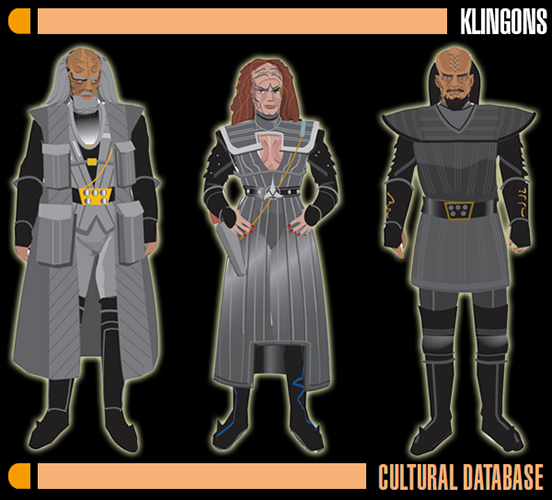
Klingons are a humanoid species evolved from an early predator on the planet Qo'noS. Internally, Klingons are more robust than most other humanoids with multiple redundancies in their organs, a principle they called brak'lul. The most distinct feature of the Klingons is their cranial ridge, which begins on the forehead and often continues over the skull, tapering towards the base of the skull. Klingon cranial ridges are as unique as fingerprints and range from barely noticeable to heavily contoured. Due to a genetic virus epidemic in the mid-22nd century, some Klingons lack cranial ridges completely, leading to them having an appearance almost indistinguishable from humans. The affected Klingons came to be known as QuchHa', and would pass these traits on to their offspring, but between gene treatments and cosmetic surgery there are few who remain in the Empire today. Klingon skin tones vary widely, even more than humans, from ash grey to almost black, with various hues of brown, red and even purple. Klingons are generally stronger than most other humanoids, and have purple colored blood.