STELLAR CARTOGRAPHY - THE KARISHI CIRCUIT
The Karishi Circuit is a loose affiliation of seven inhabited worlds linked by a common transportation network. The Circuit is often referred to as the 'Rishi Circuit or simply as The Loop.
This information is primarily sourced from information provided by the three surviving crew of the Xersian trade vessel Karakoral encountered by the U.S.S. Melbourne, along with observations made by the crew of the Melbourne.
BACKGROUND
The Karishi Circuit is named for the Karishi people, who invented the technology behind the Circuit and built and controlled it. The exact dates are unknown, but sometime between 200 and 300 years ago the Karishi developed a form of warp theory, but development of technology based on the theory was limited by power generation capabilities. The Karishi did not possess matter-antimatter technology, so were limited to fusion power. Early Karishi faster-than-light (FTL) craft were by necessity very large, but this was sufficient to explore the immediate sector and so discover other Class M worlds, some uninhabited that became colony worlds, and two that were inhabited by intelligent, though non-spacefaring, species.
The task of constructing a fleet of the large FTL craft was daunting, so the Karishi instead developed the technology they called the Catapult. Rather than carry an FTL propulsion system on board a vessel, along with the massive numbers of fusion reactors needed to power them, the propulsion is located in a fixed facility in stable orbit in a star system. This facility is the Catapult, which is able to accelerate a vessel to FTL speeds and launch it towards a target system. One downside of the technology was that another facility was required at the target location to decelerate the vessel.
Over the course of the next century following the invention of the technology the Karishi built Catapult facilities in each of the star systems they had established colony worlds in as well as the two already inhabited systems they had discovered, the worlds of Xersia and Dargura. Each system had a single Catapult, designed to accelerate vessels towards a single other system and to decelerate incoming vessels from another single system. By the present day this had created a chain of seven systems linked by Catapult, officially referred to as the Karishi Circuit.
A growing trade system has built up, where dedicated trading vessels would travel from system to system along the Circuit, or the Loop as it has come to be called, trading goods acquired from the previous system for new goods at the arrival point, then taking those goods onward to the next system in the Loop. Veteran traders prided themselves on how many times they had completed the entire Loop. The majority of traders were Karishi, though in recent decades many Xersians have become crew on Karishi vessels, and a handful have been able to acquire trade vessels of their own.
TECHNOLOGY
Based on the information provided by the Xersian trader captain Barjorad Pentajonofflin and his engineer Lajanada Frelakaffalin, the Catapult appears to work by accelerating a vessel to anywhere from 92% to 95% the speed of light, while simultaneously enveloping the vessel in what is likely a form of static subspace field. The subspace field helps negate the mass and energy restrictions of travel close to the speed of light while also distorting the space-time continuum such that the vessel's relative velocity reaches anywhere between 1.3 and 2.2 times the speed of light (an equivalent susbpace field effect of 1.1 to 1.3 cochranes). The exact real space and subspace velocities were dependent on the size and hull design of the vessel being accelerated, as well as the power provided by the Catapult, which could vary depending on the fee paid by the vessel. Sublight acceleration and deceleration was achieved with a combination of magnetic linear accelerator and a subspace/graviton project that appears to function like a primitive tractor beam.
Catapults were limited to launching vessels to a single target system, and receiving vessels from a separate single system due to limitations in the ability to change the orientation of the massive Catapult facilities and the precise targeting required to enable outgoing vessels to reach their destination accurately, and to pinpoint incoming vessels for deceleration. The sheer size and cost of constructing a Catapult facility limited them to one per system. The Karishi built and operated the Catapults, though the one in the Xersia system had some Xersian crew. The relatively small number of vessels with their own FTL propulsion systems were all controlled by the Karishi and were dedicated primarily to exploration and colonization efforts.
TOPOGRAPHY
The Karishi Circuit links seven separate star systems via Catapult systems. The entire Loop is approximately 72 light years long, though due to relativistic effects the crews of vessels generally experience time at roughly 30% of the normal rate. This time dilation effect, combined with the FTL speeds, means that it would take a trader vessel 40 to 50 years to traverse the entire Circuit but the crew would only age 12 to 15 years in that period.
The specific, real space lengths of each branch of the Circuit are:
- Risholm (Karishi Homeworld) - Thishri* [10.2 ly]
- Thishri* - Xersia [10.8 ly]
- Xersia - Chaho* [7.6 ly]
- Chaho* - Belvara* [12.1 ly]
- Belvara* - Dargura [7.8 ly]
- Dargura - Asmiar* [10.0 ly]
- Asmiar* - Risholm (Karishi Homeworld) [13.4 ly]
* denoted a Karishi colony world
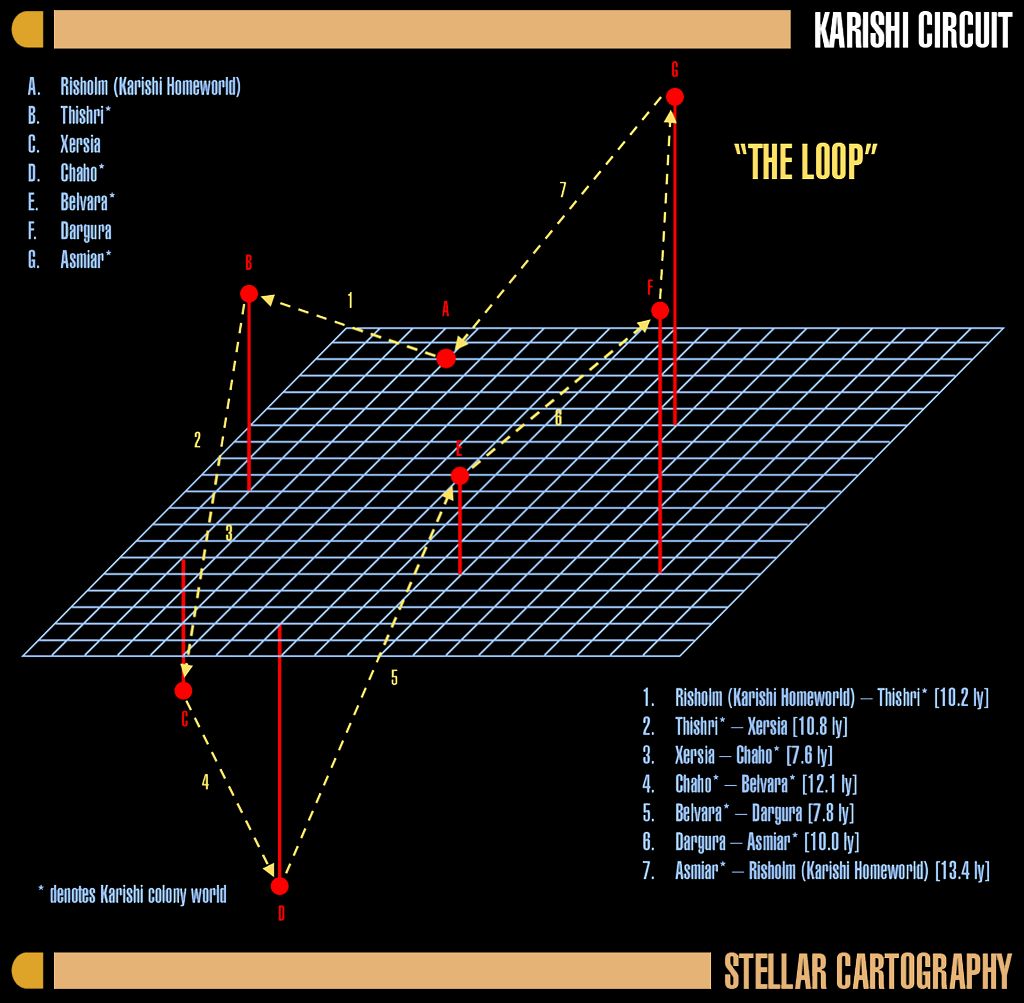
WORLDS OF THE KARISHI CIRCUIT
There are seven worlds in the Karishi Circuit. As noted, all data possessed by Starfleet on these worlds is based on information provided by the three surviving crew of the Xersian trade vessel Karakoral.
- Risholm: This is the homeworld of the Karishi people. The planet is now uninhabited, with the population as well as most, if not all, life on the planet also wiped out. The exact cause of this disaster is presently unknown, but appears to be the result of a cataclysmic result of an attack by an unidentified entity. Barjorad Pentajonofflin describes the Karishi as humanoid, taller and more slender than Humans, with pale skin, slanted eyes and small noses. Their bodies are generally hairless, except on top of the head where they typically grow long, flowing hair that ranges in color from light blonde to silver white.
- Thishri: This was the first colony world established by the Karishi.
- Xersia: Home of the Xersian species. Xersia is a low-density, mostly forested, terrestrial world. Lack of metals and radioactives restricted the technological development of the Xersians until they were contacted by the Karishi. Xersians are humanoid, descended from arboreal primates. They are on average smaller than the average Alpha Quadrant humanoid and their bodies are covered in a fine fur. They possess long, pointed ears and wide set eyes, with the skin where visible having a tan color. Their faces are bare, though surrounded by a mane of hair. Hair and fur color on the males ranges from dark brown to auburn while the females have lighter color ranging from light brown to almost blonde, and females also have lighter skin tone and their manes do not cover the chin. Xersians have three fingers and an opposable thumb, with their fingers long and tapered for excellent manipulation capability.
- Chaho: This is a Karishi colony world.
- Belvara: This is a Karishi colony world.
- Dargura: Home of the Tofari species. According to Barjorad Pentajonofflin, Dargura is primarily an agricultural world. He describes the Tofari as centaur-like quadrupeds, who were also relatively primitive until contacted by the Karishi. The Tofari are unable to leave their planet, due to an apparent biological restriction related to circadian rhythm that is potentially lethal to them if they leave Dargura.
- Asmiar: This is the newest Karishi colony world in the Circuit.