Gorn Hegemony
The Gorn Hegemony is the governmental body of the Gorn, a reptilian species first encountered by the United Federation of Planets in the mid-23rd century. The Gorn are historically hostile to outsiders and fiercely protect their territory.
History
Gorn isolationism means little is known about the history of the Gorn and the Hegemony. They were known to Orions as early as the mid-22nd Century, but the Federation did not encounter them until the mid-23rd. The initial encounters were universally hostile, starting with Gorn attacks on Federation vessels that inadvertently strayed into Gorn territory. These attacks left few, if any, survivors and so there was little information on the attackers. An invasion of Federation space by the Gorn was barely avoided in 2260, and formal First Contact did not happen until 2267. This year a Gorn vessel attacked and destroyed a Federation colony on Cestus III. The USS Enterprise under Capt. James T. Kirk responded and pursued the Gorn vessel into the territory of the previously unencountered Metron. The Metron were powerful non-corporeal beings who forced Kirk and the commander of the Gorn vessel to battle each other, but they were impressed when Kirk spared the Gorn's life. The Gorn were also impressed by Kirk's victory, and formal communications were finally established between the Hegemony and the Federation.
What came from these formal communications was fixing the borders between the Gorn Hegemony and the other Beta Quadrant powers. From behind this border, the Gorn tolerate no incursions of any kind into their space. The closed border kept the Hegemony out of the Dominion War, despite suspected efforts of the Dominion to infiltrate the Hegemony. One effect of the War and its aftermath has been the drawing out of the Gorn Hegemony to take a more active role in galactic politics. This has led to the presence of Gorn outside of the borders of the Hegemony in generally peaceful interaction with members of other species.
Government
Even with the recent opening up of relations, little is still known about the government of the Gorn Hegemony. The ruling body is called the Gorn Assembly, with an executive head of government whose title has been translated at different times as King (or Queen), Autarch, or Imperator. While this implies an inherited position, and there are indications of the existence of royal bloodlines among the Gorn, the role of supreme leader appears to at least at some points in history being one appointed by the Assembly or possibly earned through competition. Gorn society is a meritocracy, with leadership positions going to the Gorn who has demonstrated themselves as the most capable within a particular field, regardless of their gender, family, or political association.
The Gorn are seen as an aggressive species who value strength. This extends to their military, with service being seen as one of the more honorable professions a Gorn can undertake. The Gorn have a large space fleet and aggressively patrol their borders. Gorn technology is generally considered on par with Federation and Klingon, especially when it comes to weaponry.
Physiology
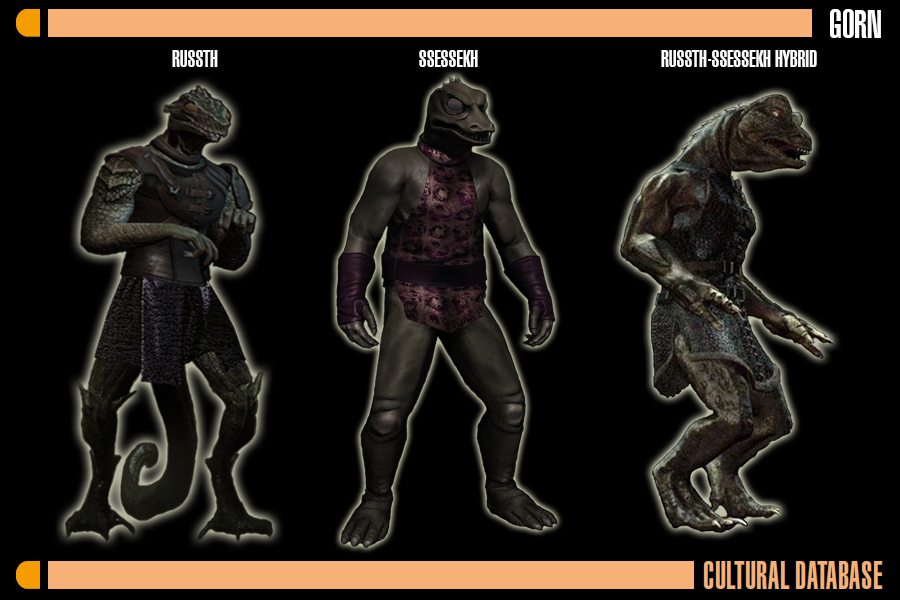
The Gorn are not a single species but rather several interrelated bipedal reptilian species that share many common physiological features. The two known species (or sub-species) of Gorn are the Russth and the Ssessekh. The Russth are the smaller of the two most commonly encountered Gorn species, standing 2 meters tall. They are less heavily muscled than their cousins, although still possessed of prodigious strength. Russth can be identified by their legs, which are of digitigrade design (meaning that they walk on their toes, like birds, dinosaurs, canines and felines, giving a "crooked-legged" appearance.) and a long tail. The Russth also possess a longer neck than the Ssessekh, and a more tapered head, more like the Velociraptor of prehistoric Earth. Their eyes are golden, with a reptilian slitted pupil, and their hands are three-fingered plus an opposable thumb, and clawed. The Ssessekh stand between 2.5 and 3 meters tall, and are massively muscled. They are easily identified by two distinct features: The eyes of the Ssessekh are silver-hued and segmented like those of an insect and Ssessekh legs and feet are of plantigrade design (meaning they walk on the soles of their feet, giving a "straight-legged" appearance, like those of a humanoid). Female Ssessekh also appear to possess a pair of breasts despite being reptilian in origin, though these may be a completely different physical aspect of the Gorn that simply resembles mammalian breasts.
One of the more disturbing aspects of Gorn physiology to other species are their method of reproduction and child-rearing. The Gorn generally hatch from parasitic eggs that incubate inside hosts. In the earliest encounters with the Gorn, these hosts were frequently humanoids taken from ships the Gorn attacked, but since normalization of relations with the other galactic powers in the late 23rd Century it is believed that the Gorn now rely on non-sentient hosts. The hosts are deposited on planets the Gorn select as breeding worlds while the young gestate. The maturation cycle varies depending on the species of the host, lasting from days to months. When ready, the hatchlings or younglings rip their way violently from the body of their host, killing the host. Gorn hatchlings would begin to grow at a rapid rate and relied on hunting instincts to find food as well as fight amongst themselves for dominance. Adult Gorn periodically return to the planets to harvest their young once they have reached a certain level of maturity.
Though intelligent, the Gorn also possess strong instincts. They are capable of speech, appearing to others as a range of hissing sounds, but the Gorn also communicate through patterns of light. Iin fact some stellar phenomena can trigger strong instinctual reactions in the Gorn, leading to reactions from periods of aggressive expansion to ones of docility bordering on hibernation.
These aspects of the Gorn are generalities. The Russth and Ssessekh are capable of interbreeding, producing hybrid offspring with a mix of traits from both species. Even within the species there is a great genetic variety, and it is theorized that Gorn young that incubate inside hosts may even inherit genetic traits from the host. This might explain reports of some Gorn bearing live young.